Serious drain and sewer problems usually do not begin with a dramatic backup. More often, they start with smaller warning signs that are easy to dismiss until the problem spreads through a larger part of the system. For commercial properties, that delay can turn a manageable repair into a disruption that affects tenants, restrooms, kitchens, operations and cleanup. EPA notes that sewer overflows and backups can cause property damage and create public health risks because they may involve raw sewage.
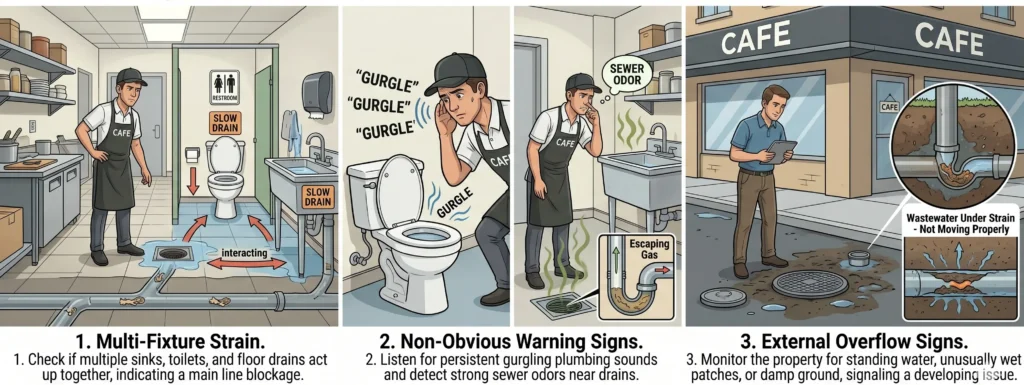
One of the clearest early signs is when multiple fixtures start draining slowly at the same time. A single slow sink may point to a local clog, but when toilets, floor drains, sinks or showers begin acting up together, the problem may be farther down the line. Utility guidance from Fargo and South St. Paul says slow drainage across multiple fixtures, wastewater backing up at the same time, or one fixture affecting another are signs of a sewer blockage rather than just an isolated drain problem.
Gurgling sounds are another warning sign people ignore too often. King County and the Washington State Department of Health both list gurgling plumbing, slow drains and backups among common signs of a failing wastewater system. That noise often means air is being displaced because water is not moving through the line the way it should. It does not always mean an emergency is happening at that moment, but it can be an early sign that the system is under strain.
A persistent sewer odor also deserves attention. Bad smells near drains, floor drains, utility areas or outside portions of the property may signal wastewater problems, dried traps or sewer gases escaping where they should not. King County includes bad odors among the warning signs of system failure, and Portland asks residents and businesses to report sewer-related odors because they can indicate a sewer issue.
Outside the building, standing water, damp spots or unusually wet areas can be another sign that a drain or sewer issue is developing. Health and utility guidance points to wet spots and standing water as signs that wastewater may not be moving properly through the system. In some cases, that can mean the problem is no longer contained inside the pipe.
What causes these problems varies. Portland says sewer pipes can become plugged with wipes, garbage, debris or grease, while other utilities warn that tree roots can enter through defects or openings and lead to blockages and breaks. That is why repeated “small” symptoms matter. Slow drains, odors, gurgling and multiple fixtures acting up are often not separate annoyances. They are different signs of the same developing problem.
The practical takeaway is simple: the earlier a drain or sewer issue is identified, the better the chance of fixing it before it turns into a backup, shutdown or expensive cleanup.